Understanding Older Adults’ Experiences with Public Benefits
TL;DR
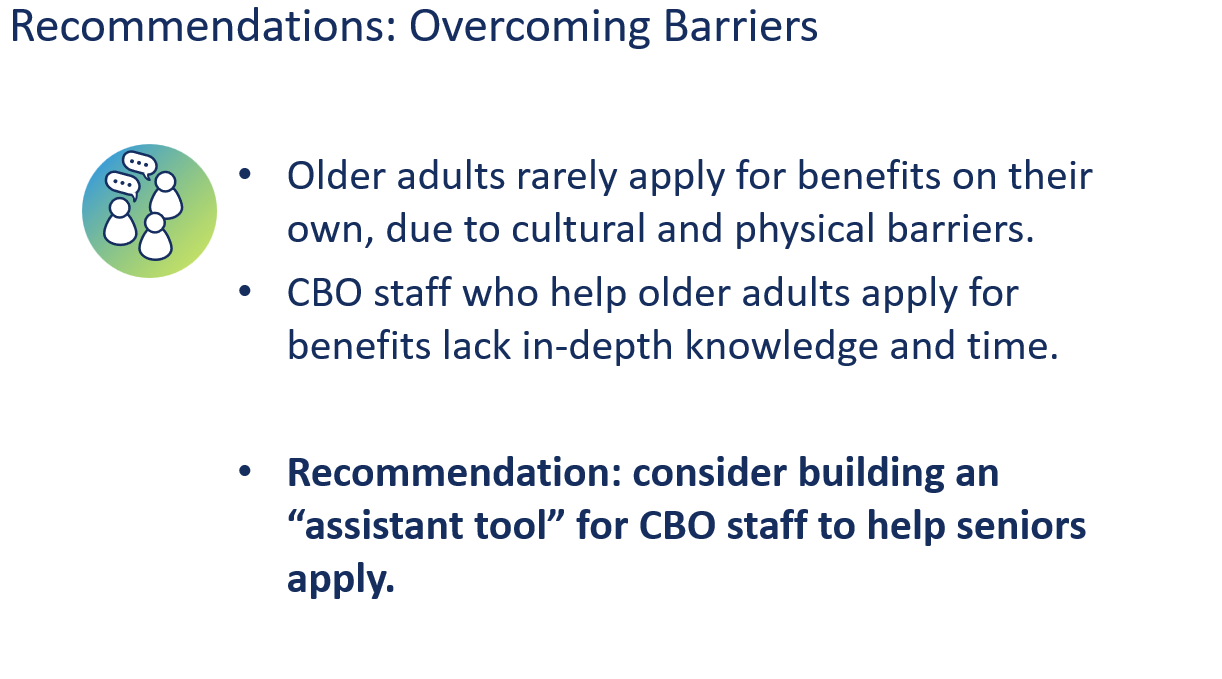
I led a six-month study to understand the experiences and needs of rural, older adults in their journey to public benefits access. My insights on barriers and opportunities for this particular group led to a shift in product strategy away from serving seniors directly to instead developing a screening tool for caseworkers.
Research type: Formative/Discovery
UX skills: In-depth Interviews, Survey
My role: UX Research Lead
Cross-functional team: UX Research, Product Management
Timeline: Six months
Context
Public benefits are an effective means of improving outcomes for older adults: Adults over the age of 65 who use SNAP (Supplemental Nutrition Assistance Program) have fewer medical expenditures, are less likely to be hospitalized, and are less likely to be admitted into nursing home facilities. Unfortunately, 66% of eligible adults 60+ in Colorado are not enrolled in SNAP (this project was focused on Colorado due to grant funding).
A national nonprofit that connects eligible people to government programs wanted to better understand the barriers seniors face in accessing public benefits, and how nonprofits and community-based organizations can support them in applying for benefits. One idea for this support was to build a digital tool for seniors to more easily apply for benefits.
Process
RESEARCH QUESTIONS
1. What are the challenges and opportunities in benefits access for older adults in rural and frontier communities?
2. What communication media and messaging will increase the likelihood that an older adult will apply for benefits?
3. What language resonates with older adults in rural and frontier communities around benefits and technology?
METHODS & RECRUITMENT
- In-depth interviews with 11 Community Based Organization (CBO) staff in rural Colorado
- In-depth interviews with 25 older adults (50+) with either 1) previous benefit application experience or 2) difficulty paying for basic needs, living in rural Colorado
- Survey of 43 CBO staff
I decided to talk to both people who used benefits and the staff at CBOs who assist with benefit applications to get the full picture of challenges, needs, and opportunities in this space. I conducted a survey after the interviews to validate some of the interview findings.

Analysis & Synthesis
I analyzed the data using thematic analysis across all the interview transcripts. I then used the key findings to create a survey to validate the key findings, e.g., top barriers in benefit access. Combining the interview and survey data (both quantitative and qualitative) strengthened the insights.

Outputs
RESEARCH REPORT AND BLOG POST
I wrote a detailed report with findings and recommendations to inform content strategy and product strategy, as well as a more digestible presentation for sharing with leadership. Working with the Comms team, I published my findings in a public blog post to help inform policy and practice in the field.

Impact
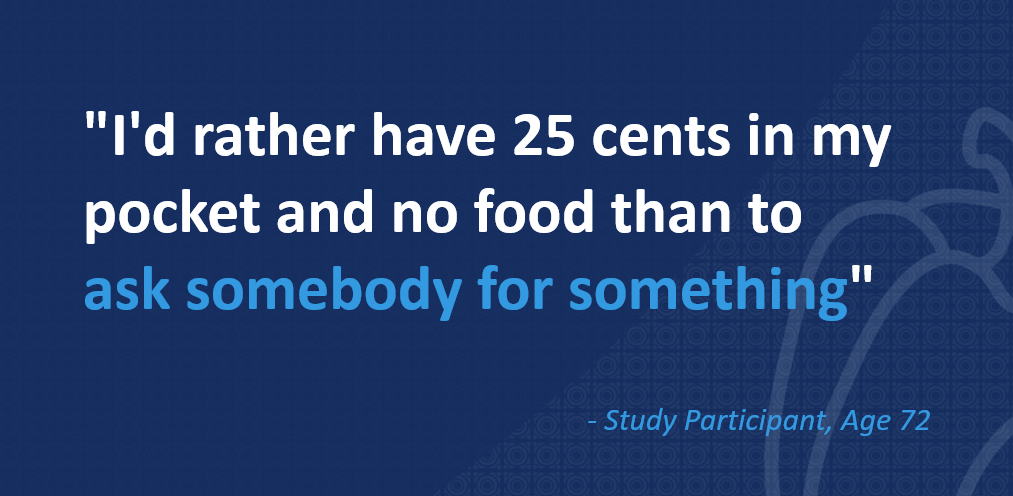
- Change in outreach letters to likely eligible seniors to address the “mistrust in government” barrier.
- A/B testing of different messaging to see what language is most effective
- Prioritized build of “assisted quick screener” tool for CBO staff on the product roadmap
Reflections
Ideally this project would have been done in person, with some ethnographic/field research to more authentically understand the experiences of people trying to access public benefits in rural and frontier areas. Unfortunately, it was the middle of Covid and I had to forego this field study aspect which would have yielded much richer data.
It was difficult to connect with people in rural areas over video interview because of internet connection issues and people not owning computers. Instead, I did interviews over the phone. I would have preferred video so I could capture nonverbal insights as well.
 Urszula Pruchniewska, Ph.D.